
Expecting an Audit? Temperature Monitoring Record
Many of our clients take the simplest element of our service, which is the prompt warning if any temperature sensor moves out of its zone of normal operation. They fix the issue and get on with life. Don't look back.
But if you are in the position of having to demonstrate concisely that your setup is being properly minded, then you'll be helped by our Temperature Monitoring Record. Your audience may be insurers, industry regulators, or your Boss. Sometimes also called a Cold Chain Management Record, the design for this month-view summary was proposed by the NZ Ministry of Health back in 2012. It is also endorsed by Te Whatu Ora.
The Pharmaceutical Society of NZ offers a further insight by demonstrating this example of a manually completed record:
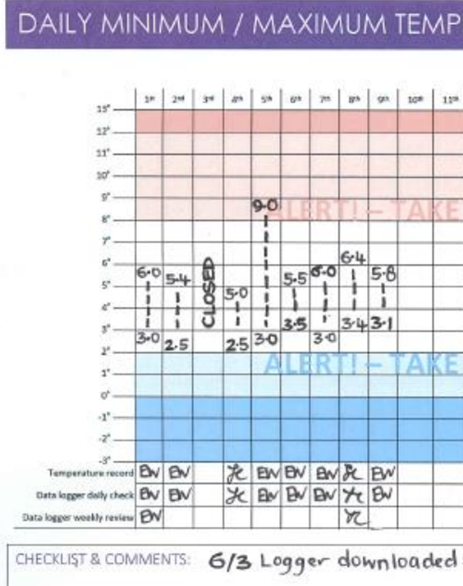
It's pretty likely that you can't spare staff to attend to this chore robustly on an hour basis. And will it get done outside of office hours? In which case you'll appreciate the Wayward Monitoring service providing you with a better temperature audit record, reliably 24/7, and downloadable in PDF format. Very suited for email distribution or an end-of-year report.
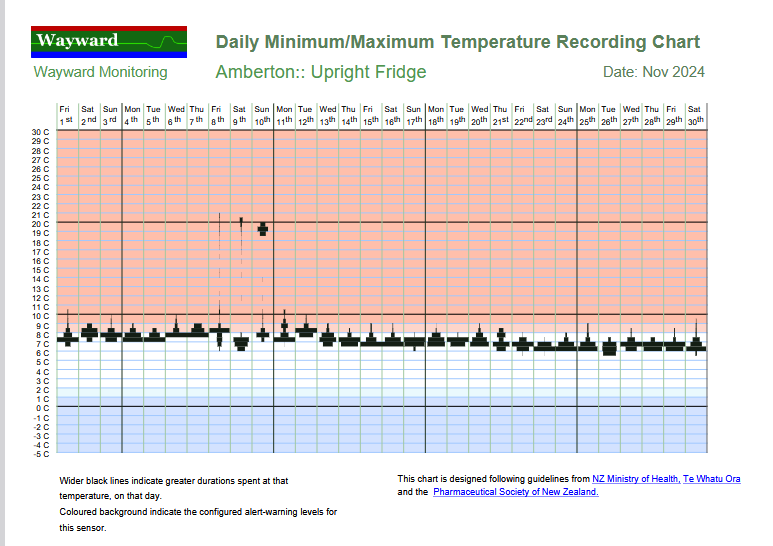
To build this report, we divide the temperature range into half-degree slices, then tot up what percent of each day was measured in that range for the chosen sensor. The black bars are wider for the greatest percentage of time. The pale blue and pink background zones denote the minimum and maximum warning levels, configurable for each sensor. (These are the same levels which apply when Wayward issues Email or SMS messages for temperatures going out of bounds).
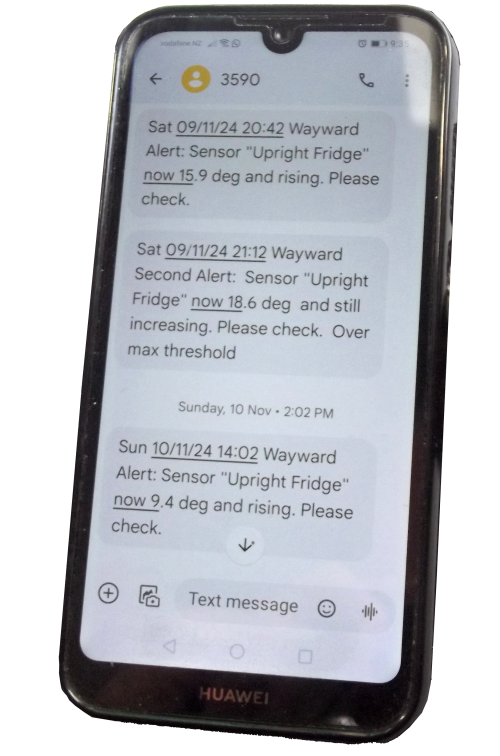
The above example shows that this sensor is generally well-behaved, staying in a narrow zone between 6 and 9 deg. It occasionally drifts slightly higher, and the 8th to 10th of the month reflects a noteworthy stretch at room temperature for a portion of the day (the sensor had been moved outside of the fridge for some task, prompting the expected flurry of SMS messages from the Wayward alert system).
By way of contrast, here is the equivalent report for a sensor in a residential area at room temperature.
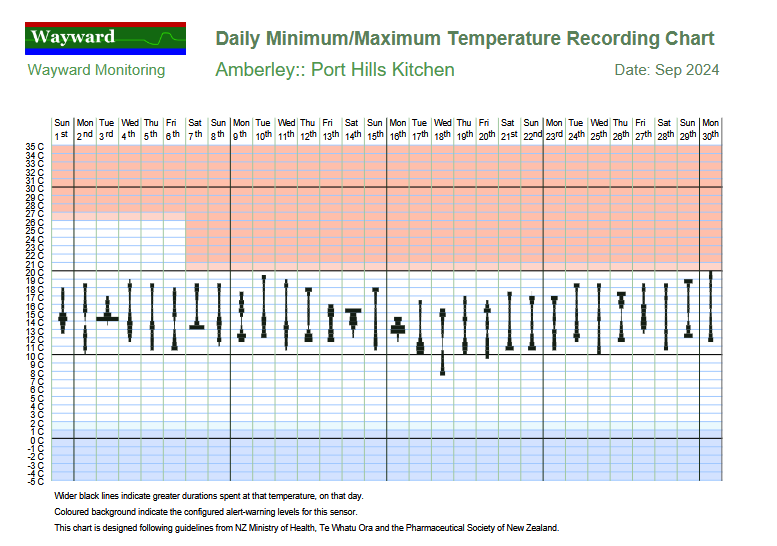
Instead of being bunched at 6-9 degrees, as happened in the previous report, the temperatures here are distributed on a wider range between chilly and comfortable, as expected in an area with plenty of activity.