
The inconvenient truth about manual temperature testing
Once upon a time there were only daily checks of vital cold storage
A staff nurse would take a physical thermometer check. Normally just once a day and logged into a record book.
Nowadays you have smart technology to help you…..
Technology can check temperatures every six minutes and raise alerts if over 2-8 deg limits.
We carried out a test to quantify two options of medication checks
Using the latest Wayward Monitoring app, we logged the number of alerts logged. By time of day over a period of 12 months. Eight fridges were involved
Not surprisingly we saw more alerts activity around 10 am. Overall, some of that activity can be attributed to a weekly fridge clean, but in staff slack periods potentially at night time. Eg times 0am and 22pm.
The main number of recorded alerts occurred 10am to 15am with a slight surge in evening medication treatment.
The first graph reflects real time alerts where temperature was seen to be exceeding or about to exceed 8deg. For the second graph representing the historical daily test we have assumed same conclusion from a thermometer check at 10am.
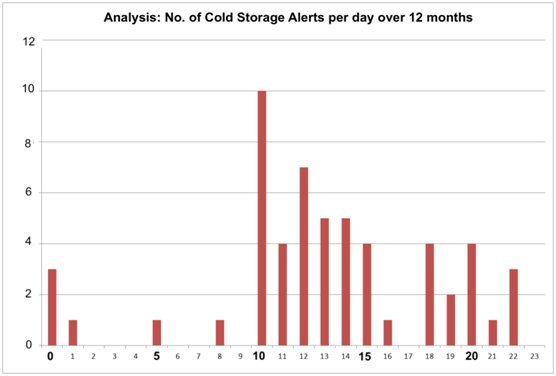
Result:
With automated temperature monitoring, 57 Alerts would be generated and resolved on the spot by duty staff.
Across 8 Cold store/medication units.
Over 12 month period
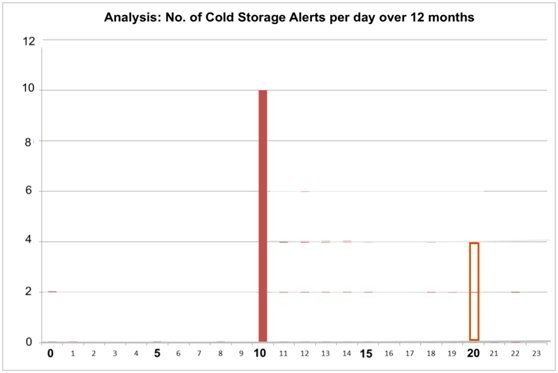
With manual temperature monitoring :
10 exceptions logged
Across 8 Storage units
Over 12 month period.
Applying a second 8 unit thermometer test at 8pm would log 14 exceptions total
Fridge Cool Monitoring - The Inconvenient Truth
Monitoring the well-being of medications and food in end user cold storage has been with us for many years. During that time, the humble thermometer has been the main manual tool for logging and wellbeing of medications and foods
Now however, new technology is now offering the ability for sensors to manage the detail more closely. So how does it compare? Has the use of manual thermometer logging actually been effective over the last 10-15 years?
This comparative analysis covers a period of 12 months and shows how the two options for cold storage temperature logging compare for accuracy.
Conclusions are not difficult to draw.
Essentially, what is likely to happen if 43 temperature overshoots were not detected over that 12 months period? Potential medication degradation?
It is important to note that the current procedures are official historical directives from District Health Boards. These regulations are based on what was practically possible at the time, and don’t reflect latest technology.
There would also appears to be an undercurrent of fridge-faith that assumes fridges work OK till they break down. In our data study, a lot of temperature deviations were usage driven, overloads, non closures etc.
Technology provides concrete evidence, not perception.